CareerPrepped is a comprehensive system, thus, before getting started with implementation, identify your goals. Do you want to embed soft skills into core curricula to improve student career-readiness? Do you want students to have a Career Portfolio of skill evidence upon graduating? Do you want to improve students’ ability to articulate their skills? How you implement will depend on your goals and the partners you may need to get onboard to help you achieve them. Some implementation ideas are presented below:
Embed Skill Builders in core program curricula to scaffold students’ soft-skill development.
Use Skill Builders as course assignments in advance and use timetabled experiences to engage students in scenarios, role plays, problem- solving, and group work (this is sometimes referred to as “flipping the classroom”).
Re-imagine assessments in your existing courses to ensure there’s a balance between testing knowledge, traditional exams (if appropriate), simulated and scenario-based assessment, and team tasks that emulate real workplace tasks.
Design assessments that require students to create portfolio evidence that can be shared with potential employers.
Identify milestones for each program of study for faculty/Program Chairs/Deans to review students’ Career Sites, Career Portfolios, and/or Skill Badges as a summative assessment to evaluate career-readiness progression. From this “check-up,” intervene with students as necessary to help those who may be behind or having trouble.
Claim your own Skill Badges and build your own Career Portfolio and Career Site as an example to model for students.
Review the Career Sites, Career Portfolios, and/or Skill Badges of students from the class roster for every class for consistent feedback to students throughout the student life cycle. Consider leaving feedback for students in comments on their portfolio files and/or CareerPrepped messaging system, or recording feedback in your institution’s preferred tool.
Create formal recognition programs to motivate students and encourage the use of CareerPrepped resources from your own developed standards (e.g., Best Portfolio Awards, Best Career Site Awards, or Best Skill Badges Awards.)
Award students publicly such as at commencement, publishing student award recipients in newsletters, social media, the school’s blog or website, or highlighting students on the wall of a physical campus in a high-traffic area.
Create extracurricular programs using CareerPrepped Skill Builders and tools to give students an opportunity to distinguish themselves. Example: A “Career Readiness” program built from selected Skill Builders with GPA and attendance requirements. Establish requirements for portfolio evidence, Skill Badges, and a one-minute video of the student summarizing their unique capabilities acquired from the program to be embedded in the summary section of their CareerPrepped Webpage. (Refer to Deakin University’s Me in a Minute program here: https://blogs.deakin.edu.au/meinaminute/. The YouTube channel for Deakin’s “Me in a Minute” videos is here: https://www.youtube.com/user/deakinmeinaminute.)
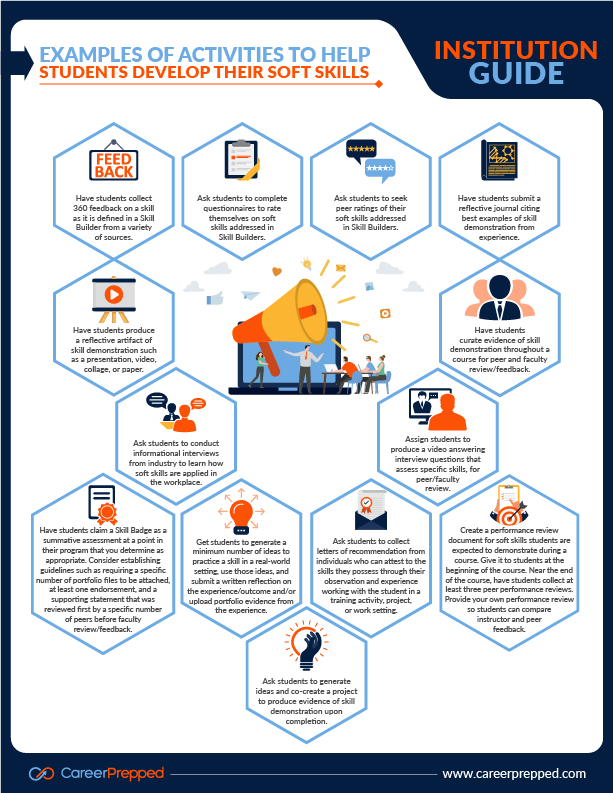
Examples of Activities to Help Students Develop their Soft Skills
Have students answer and submit their responses to reflection questions in Skill Builders you assign them. Our system lets them download their responses as a Word document so they can submit them via your Learning Management System
Have students complete and submit skill challenges from Skill Builders you assign them
Have students collect 360 feedback on a skill as it is defined in a Skill Builder from a variety of sources
Ask students to complete questionnaires to rate themselves on soft skills addressed in Skill Builders
Ask students to seek peer ratings of their soft skills addressed in Skill Builders
Have students submit a reflective journal citing best examples of skill demonstration from experience
Have students produce a reflective artifact of skill demonstration such as a presentation, video, collage, or paper
Have students curate evidence of skill demonstration throughout a course for peer and faculty review/feedback
Ask students to conduct informational interviews from industry to learn how soft skills are applied in the workplace
Assign students to produce a video answering interview questions that assess specific skills for peer/faculty review
Get students to generate a minimum number of ideas to practice a skill in a real-world setting, use those ideas, and submit a written reflection on the experience/outcome and/or upload portfolio evidence from the experience
Ask students to generate ideas and co-create a project to produce evidence of skill demonstration upon completion
Create a performance review document for soft skills students are expected to demonstrate during a course. Give it to students at the beginning of the course. Near the end of the course, have students collect at least three peer performance reviews. Provide your own performance review so students can compare instructor and peer feedback.
Have students claim a Skill Badge as a summative assessment at an appropriate point in their program you should determine. Consider establishing guidelines such as requiring a specific number of portfolio files to be attached, at least one endorsement, and a written justifications that were reviewed first by a specific number of peers before faculty review/feedback
Ask students to collect letters of recommendation from individuals who can attest to the skills they possess through their observation and experience working with the student in a training activity, project, or work setting
Image Format Below: